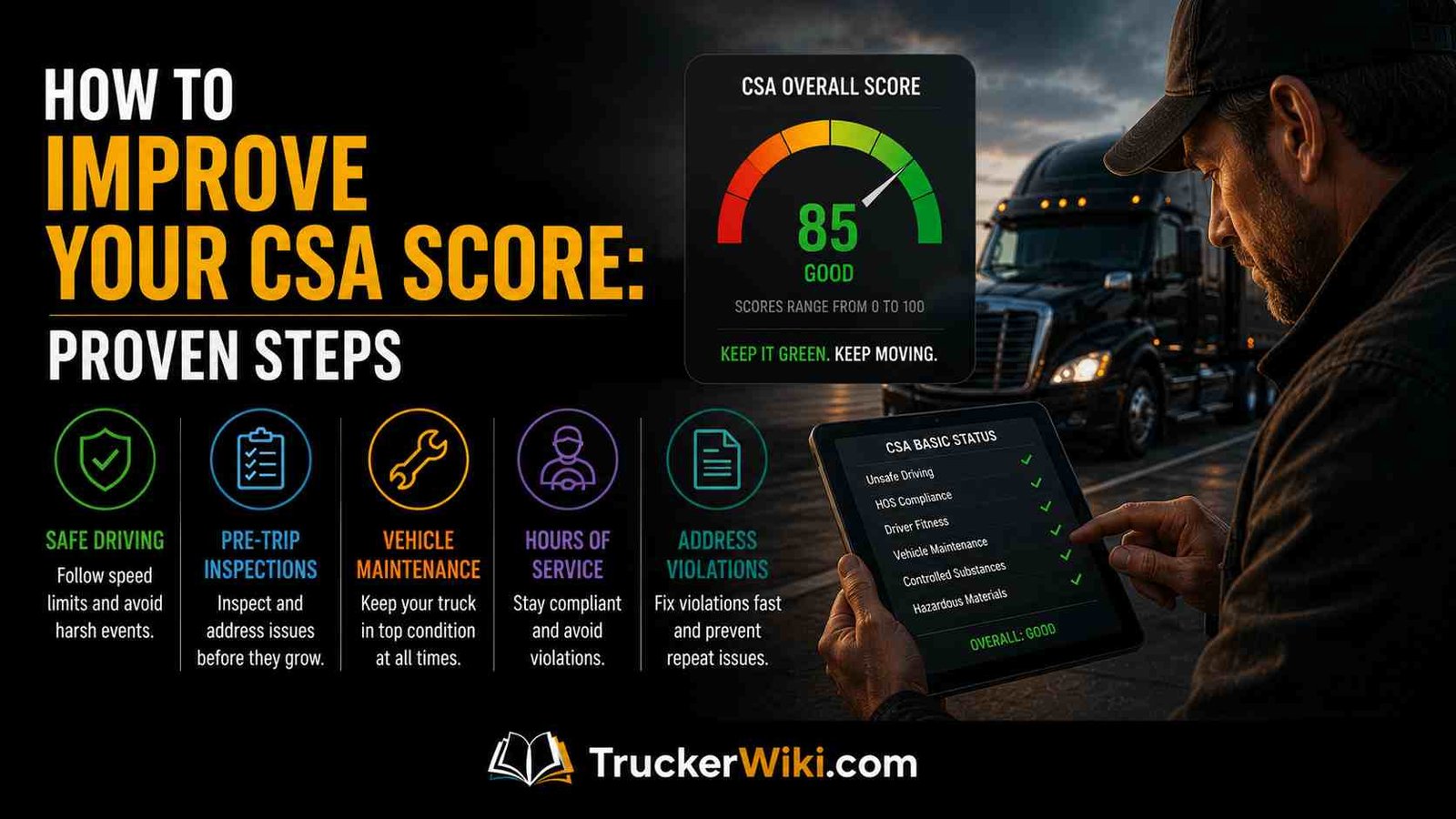
How to Improve Your CSA Score: Proven Steps
Improving a carrier’s CSA BASIC percentile comes down to three levers: preventing new violations from entering the scoring window, removing inaccurate data through DataQs challenges, and accumulating clean inspections that push the percentile down through positive scoring data.
No single action produces an immediate dramatic result. The SMS is a 24-month rolling calculation; improvement happens in the direction of the data over time, not overnight. The fastest path to a lower percentile is to stop entering new violations at the BASIC level that are above the threshold, because recent violations carry three times the weight of older ones in the SMS calculation.
This article covers each lever in order of impact, the specific math behind the time-weighting system, and the actions that consistently produce measurable percentile movement. For the full background on how BASIC percentiles are calculated and what thresholds trigger FMCSA intervention, see the CSA Score Explained article first.
Understand the Time-Weighting Math Before Choosing Your Strategy

The most important structural fact about CSA score improvement is the time-weighting system. Violations within the SMS 24-month window are not equally weighted. Per FMCSA’s SMS methodology, violations are time-weighted as follows:
- Violations in the most recent 6 months: multiplied by 3x
- Violations from months 7 through 12: multiplied by 2x
- Violations from months 13 through 24: multiplied by 1x (face value)
- After 24 months: drop out of the SMS calculation entirely
The practical consequence is that a violation from last month has six times the mathematical impact on the BASIC percentile as the same violation from 18 months ago. A carrier with an elevated BASIC that is mostly composed of older violations in the 13-24 month range is in a meaningfully different position than a carrier with the same raw violation count concentrated in the past 6 months.
The first carrier can improve its percentile significantly just by going 6 clean months and letting the older violations shift from 2x to 1x weight and then drop off. The second carrier has to stop the input of high-weight violations immediately or the score will continue to deteriorate.
The implication for prioritization: prevent new violations first, then work on existing data. The 3x multiplier on recent violations means a single new OOS violation this month does more damage to the percentile than three older violations from last year combined.
Before spending time and resources on retroactive DataQs challenges, evaluate whether the root cause of the violations is ongoing and still generating new citations. Fixing a recurring maintenance issue that produces brake violations every 3 months will produce more percentile improvement than challenging the citations after the fact.
A concrete scenario shows why this matters operationally. A carrier with 3 OOS violations at the 3x weight (past 6 months) and 2 OOS violations at the 1x weight (13-24 months old) has an effective severity-weighted total of (3 x 2 x 3) + (2 x 2 x 1) = 22 weighted units. If that carrier prevents all new violations and waits 6 months, the first group shifts from 3x to 2x weight: (3 x 2 x 2) + (2 x 2 x 1) = 16 weighted units.
That is a 27 percent reduction in weighted impact from the same violations purely through time progression with no new data. At 12 months, when those violations move from 2x to 1x, the impact drops further. At 24 months they fall off entirely. The carrier that stops generating new violations benefits from time decay on every existing violation simultaneously.
The severity weight matters too. Under the 2026 Enhanced SMS methodology, OOS violations carry a severity weight of 2 and non-OOS violations carry a weight of 1. An OOS violation is twice as damaging to the percentile as a non-OOS violation before the time multiplier is even applied. A recent OOS violation (3x time weight x 2 severity weight) carries six times the impact of an older non-OOS violation (1x time weight x 1 severity weight). High-severity, recent violations are the highest-priority target for root cause elimination.
Monitor Monthly and Use the SMS Detail View
You cannot manage what you are not measuring. FMCSA updates SMS data monthly, typically during the first week of each month. Reviewing your CSA profile once per quarter means violations from the previous 60 to 90 days may have been in the system for weeks before you noticed them. Monthly review, timed to FMCSA’s update cycle, catches changes while documentation of the underlying inspection is still recent and DataQs challenges can still be built with fresh evidence.
Log in at csa.fmcsa.dot.gov using your DOT number and PIN. The summary view shows the BASIC percentile for each of the seven categories. The detail view for each BASIC shows the individual inspections contributing to the score, the specific violations found, their severity weights, their dates, and the trend direction. This is where actionable information lives.
When reviewing the detail view for an elevated BASIC, focus on three things in sequence. First, identify the most recent violations by date; these carry the highest time-multiplier weight and represent the most urgent root cause to address. Second, identify the highest-severity violations, specifically OOS-producing violations, which carry double the base weight of non-OOS violations. Third, look for any attribution errors: violations assigned to your USDOT number from inspections that were not your driver or your vehicle. Attribution errors are the most straightforward DataQs challenge and the fastest route to data removal when they occur.
Setting a calendar reminder for the second or third week of each month to review the SMS dashboard is the most underutilized compliance habit in the industry. Foley Carrier Services’ March 2026 analysis noted that most carriers never check their SMS score between intervention warning letters. A carrier that is monitoring monthly can initiate DataQs challenges, address root causes, and track trend direction before a score deteriorates to the intervention threshold rather than after.
For drivers monitoring their own PSP record, psp.fmcsa.dot.gov offers self-purchase for $10. Reviewing your PSP record before a job search and identifying any citations that may be challengeable through state appeal processes is the driver-side equivalent of the carrier’s monthly SMS review. A clean PSP record cannot be manufactured retroactively, but errors in PSP data can be corrected the same way carrier SMS errors are: through DataQs for attribution errors and state court processes for disputed citations.
File DataQs Challenges on Factual Errors, Not on Officer Judgment
DataQs is FMCSA’s system for requesting a review of data appearing in the Safety Measurement System. It is accessed at dataqs.fmcsa.dot.gov. A successful DataQs challenge removes the violation from the SMS profile entirely and recalculates the BASIC percentile as if the violation never existed.
The critical limitation that most drivers and carriers misunderstand: DataQs handles factual errors in data, not disputes about whether a violation should have been issued. If you believe an officer incorrectly cited a regulation, or that the officer’s professional judgment was wrong, the appropriate mechanism is the state citation appeal process through the court with jurisdiction over the inspection location. DataQs cannot reverse a correctly recorded violation that you simply believe should not have been issued.
Common challengeable factual errors in DataQs include:
- Wrong USDOT number assigned to the inspection (the violation belongs to a different carrier)
- Duplicate entry of the same inspection
- The violation code recorded does not match the actual regulatory standard cited on the Driver/Vehicle Examination Report
- The crash record attributes a crash to a carrier that was not involved
- A violation was dismissed or reduced through court proceedings and the SMS data has not been updated to reflect the outcome
That last category is one of the strongest DataQs submissions available. If a citation was dismissed in court or reduced to a lesser charge, including that outcome documentation with the DataQs submission is among the most effective grounds for data correction, according to First Call Logistics’ review of FMCSA challenge data. The FMCSA cites an overall DataQs success rate of approximately 45 to 55 percent. Industry practitioners note that challenges with documentary evidence (maintenance records, ELD data, dashcam footage, photos from the inspection scene) substantially outperform those filed without supporting documentation.
Crashes have a separate challenge mechanism: the Request for Data Review (RDR) process. If a carrier believes a crash should be classified as non-preventable for SMS purposes (meaning the carrier’s driver was not at fault), the carrier submits an RDR rather than a standard DataQs challenge. The RDR process uses FMCSA’s preventability determination methodology; a non-preventable determination removes the crash from the SMS calculation.
DataQs challenges should be filed as promptly as possible after discovering an error, ideally within 30 days of the inspection. The sooner a challenge is filed, the more likely the documentation supporting it is complete, the officer’s recollection is available, and any dashcam or ELD data has not been overwritten.
Prevent New Violations by BASIC Category
Stopping the flow of new violations into the scoring window is the highest-leverage action for every elevated BASIC. The specific tactics differ by category.
HOS Compliance BASIC: The most preventable HOS violations are 14-hour window violations and false records of duty status. The 14-hour violations are largely a dispatch planning problem: drivers who are sent on loads that require more time than the 14-hour window allows will either drive beyond the limit or falsify logs to appear compliant.
Fixing the dispatch planning process, specifically building shipper dwell time into the route plan rather than absorbing it into the driver’s HOS, addresses the structural cause. ELD annotation discipline reduces the false RODS risk. Requiring drivers to annotate every edit and any HOS exemption invocation at the time it occurs, rather than at end of shift, eliminates the pattern of unannotated entries that inspectors flag.
Vehicle Maintenance BASIC: Brakes, tires, and lighting account for the vast majority of vehicle OOS orders and Vehicle Maintenance BASIC violations. A rigorous pre-trip inspection process, where drivers complete a physical walk-around with DVIR documentation before every dispatch, is the primary prevention mechanism.
A DVIR that documents a brake defect before the driver leaves the yard and triggers immediate repair prevents that defect from becoming a citation at a roadside inspection two states away. Carriers that have measurably improved their Vehicle Maintenance BASIC most consistently share one practice: same-day defect resolution policy where no vehicle with an open DVIR defect leaves the facility.
Driver Fitness BASIC: Driver Fitness violations are almost entirely preventable through driver qualification file management. An expired medical certificate, a missing CDL endorsement for a load type, or a suspended license that the carrier did not catch are all preventable with a monitoring system. Setting calendar reminders for medical certificate expiration dates 60 days in advance, running MVR checks annually or whenever a significant incident occurs, and verifying CDL endorsements against the load type at dispatch are the standard practices that keep Driver Fitness BASIC percentiles low.
Unsafe Driving BASIC: Unsafe Driving violations are the most difficult to prevent purely through administrative processes because they depend on real-time driver behavior on the road. Speed limiter policies governing vehicles to 65-68 mph eliminate the top-cited unsafe driving violation category. Telematics-based monitoring that flags harsh braking, rapid acceleration, and following distance violations identifies at-risk behavior before it produces a citation. Structured driver coaching based on telematics data has produced BASIC percentile drops of 15-25 points within 90 days for carriers that implement it consistently, according to My Safety Manager’s January 2026 analysis.
Accumulate Clean Inspections as Positive Data Points

The 2026 Enhanced SMS methodology treats clean inspections as positive data inputs, not just the absence of negative ones. Every clean Level I inspection that produces no violations actively improves the BASIC percentile by adding a positive data point to the carrier’s scoring pool. This is the structural reason why proactive inspection exposure, rather than avoidance, is the correct long-term strategy for carriers managing CSA scores.
The CVSA decal program is the most efficient mechanism for accumulating clean Level I inspections systematically. A vehicle that passes a full Level I inspection receives a CVSA decal valid for three months and is generally not subject to roadside reinspection during that period. Carriers that run their vehicles through Level I terminal inspections proactively, obtain decals, and then deploy those vehicles on highway routes are reducing the probability of random roadside stops while generating clean inspection records. As covered in the DOT Roadside Inspections article, only Level I and Level V inspections are eligible for the CVSA decal.
PrePass enrollment allows participating carriers to bypass weigh station stops when their compliance profile meets the weigh station’s screening criteria. A carrier with clean SMS scores is more likely to receive green-light bypass clearance at PrePass-equipped weigh stations, reducing the number of stops where an inspection could generate a new violation while still accumulating electronic clearance data.
For owner-operators with small inspection counts, the math of clean inspection accumulation is particularly important. A solo owner-operator with 5 total inspections and 1 OOS violation has a 20 percent violation rate, which translates to a high BASIC percentile in a peer group where most carriers have lower violation rates. Adding 5 clean inspections brings the total to 10 inspections with 1 violation, a 10 percent rate, which significantly changes the percentile position relative to peers. The leverage of each additional clean inspection is highest when the total inspection count is lowest, making proactive inspection participation an especially high-value strategy for small operators.
An additional benefit of proactive Level I inspections for carriers managing CSA scores: the Level I process forces the same vehicle review that a roadside inspection would perform, but in a controlled environment where defects can be repaired before the vehicle departs rather than being cited on the road. A terminal Level I inspection that uncovers a brake adjustment issue produces a repair, not a violation. The same brake condition found at a weigh station produces a violation and potentially an OOS order. The inspection is valuable not only for the clean data point it generates but for the defect detection it enables before enforcement does the same detection at a cost.
For HOS Compliance BASIC specifically, clean inspections involve a clean ELD transfer at the roadside. A driver who passes the driver portion of a Level I inspection without any HOS or ELD violations generates a positive data point in the HOS Compliance BASIC. Carriers that train drivers on proper ELD annotation, maintain compliant records, and practice data transfer before inspections occur convert potential HOS BASIC violations into clean inspection credits instead.
By TruckerWiki Editorial Team | Sources: FMCSA CSA Safety Measurement System, FMCSA DataQs system, Foley Carrier Services CSA improvement guide (March 2026), Forward Thinking Systems SMS guide (April 2026), First Call Logistics DataQs analysis, My Safety Manager fleet improvement guide (January 2026). SMS time-weighting methodology current as of May 2026.






[…] Maintenance BASIC violations from pre-trip failures connect to CSA score consequences, see the How to Improve Your CSA Score article. For the full framework of roadside inspection levels and what enforcement officers check, […]
[…] exposure onto the driver and carrier in ways that have nothing to do with FMCSA enforcement. TruckerWiki’s guide to improving your CSA score outlines how to prevent low-severity violations like this one from stacking into a larger pattern […]